Consciousness and the Everyday States of Awareness You Move Through
Consciousness is your awareness of your thoughts and surroundings, and it shifts all day — a plain-language look at focus, mind-wandering, and sleep.
Table of contents
Consciousness is your awareness of your own thoughts, feelings, and surroundings — the plain fact that, right now, there is an experience happening for you. But it isn't one fixed setting. Across an ordinary day you move through many states of awareness: sharp focus, a drifting mind, drowsiness, deep sleep, and dreaming, each with its own feel.
This is a plain-language, self-care look at those everyday states — what they are, how they show up, and small ways to work with them. It leans on mainstream references like the American Psychological Association and the Sleep Foundation, and it isn't a philosophy essay or a medical guide; nothing here is meant to diagnose anything.
What consciousness means in everyday terms
At its simplest, consciousness is your awareness of what's happening inside you and around you: your thoughts, sensations, moods, and the room you're sitting in. The American Psychological Association keeps a free, plain-language Dictionary of Psychology that defines this and dozens of related terms if you want to read further.
Brain researchers usually describe consciousness as two parts working together. One is arousal — how awake you are, running from wide alert through drowsy all the way down to deep sleep. The other is awareness — the actual content, meaning what you're noticing and thinking about. Full, ordinary consciousness needs both. That gap is why you can be technically awake yet barely aware, like driving a familiar route and realizing you remember almost nothing of the last few minutes.
What are the everyday states of awareness?
They're the different modes your mind passes through in a normal day and night: focused attention, relaxed mind-wandering, flow, drowsiness, the lighter and deeper stages of sleep, and dreaming. You don't pick most of them on purpose. They rise and fall as your tiredness, your body clock, and your attention shift. Here are the ones you'll recognize:
| State | What it feels like | When it usually shows up |
|---|---|---|
| Alert focus | Clear, engaged, one thing at a time | Morning work, an absorbing task |
| Mind-wandering | Thoughts drift, autopilot, daydreams | Chores, commuting, the shower |
| Flow | Deep absorption, time slips by | A challenging task you enjoy |
| Drowsiness | Heavy eyes, slow and fuzzy thinking | Late evening, after a big meal |
| Light and deep sleep | Little or no sense of surroundings | The first hours of the night |
| Dreaming (REM) sleep | Vivid, story-like images | Later in the night, toward morning |
The waking mind: focus and the drift
Even wide awake, your attention rarely holds still. Harvard researchers Matthew Killingsworth and Daniel Gilbert ran a well-known study using a phone app that pinged 2,250 people at random moments, and they reported that minds were wandering about 47% of waking hours — close to half the day spent thinking about something other than the task at hand. The Harvard Gazette has a readable write-up of that research.
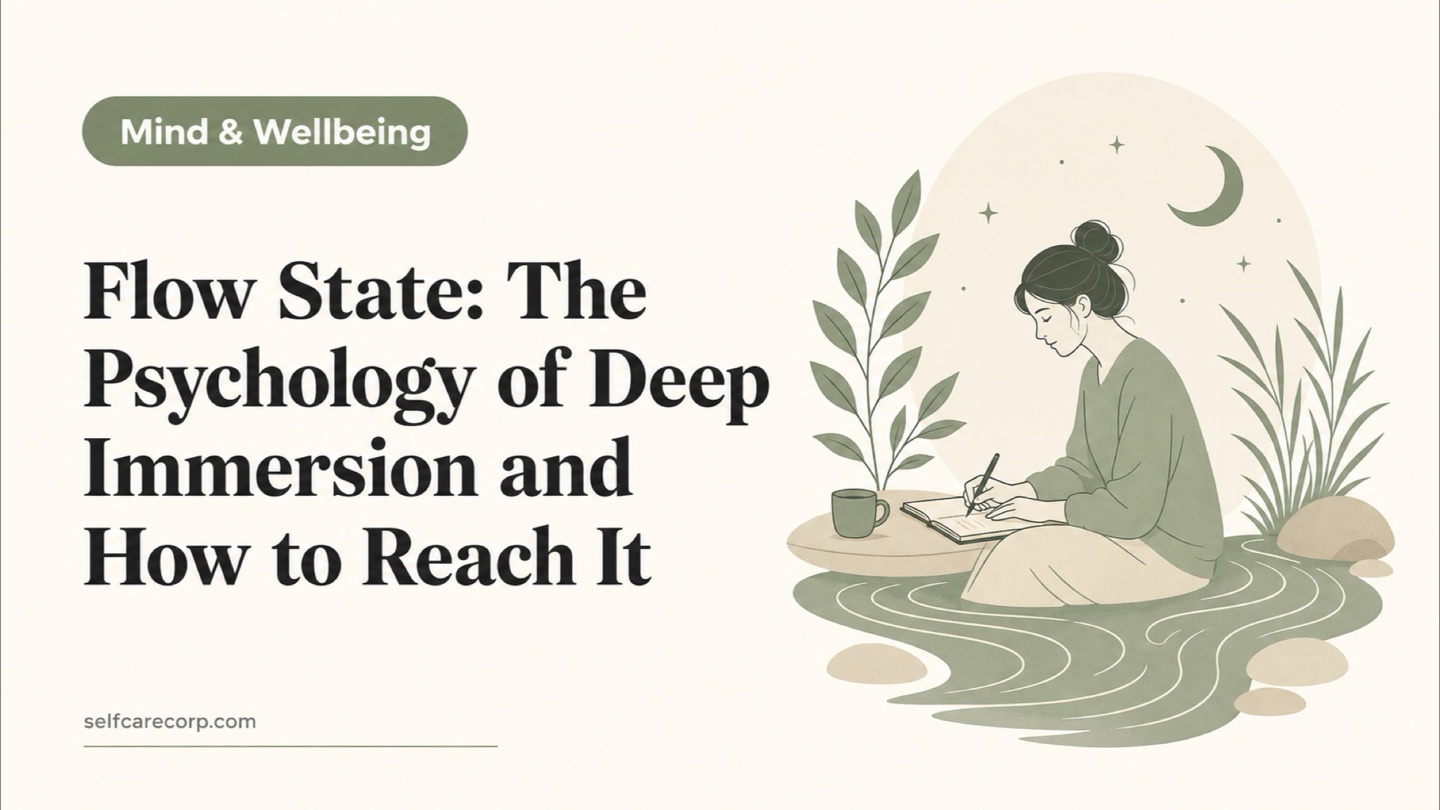
This drifting runs through a group of brain regions often called the default mode network, which switches on when your focus turns inward to memories, plans, and daydreams. Wandering isn't a flaw; it feeds creativity and helps you plan. It only stings when you'd rather be present, or when the drift curdles into looping worry. A little everyday mindfulness practice is one gentle way to catch yourself drifting and come back. At the opposite edge of the waking range sits flow, the deeply absorbed state where attention narrows to one thing and time seems to speed up.

How sleep reshapes your awareness
Sleep feels like an off-switch, but your brain stays busy, cycling through distinct states all night. According to the Sleep Foundation, sleep runs in cycles of roughly 90 minutes, and most people move through four to six of them before morning. Each cycle passes through lighter sleep, deeper sleep, and REM (rapid eye movement) sleep, the stage that carries the most vivid dreams.
The Sleep Foundation also notes that adults spend around three-quarters of the night in non-REM stages and about a quarter in REM, and that you usually don't reach your first REM stage until roughly 90 minutes after you drift off. REM periods stretch longer toward morning, which is part of why you so often wake mid-dream. You can see the full stage-by-stage breakdown on the Sleep Foundation site. Because these stages depend on steady, unbroken rest, the small habits of a good bedtime routine — a consistent sleep time, a dark room, less late-night screen light — quietly protect the whole cycle.
The in-between states most people overlook
Two of the most interesting states sit right on the edges of sleep. As you drift off, you pass through a short hypnagogic state — the loose, dreamy stretch where you might see floating images, hear your name called, or feel a sudden falling jolt that wakes you. It's normal and harmless. Some people court it on purpose, keeping a notebook nearby, because the loose, associative thinking there can shake loose an idea or two.
The mirror image happens on waking. That thick, foggy feeling in the first minutes after the alarm has a name: sleep inertia. It can hang around for a while, especially when you're yanked out of deep sleep, and it's why making a hard decision at 6 a.m. rarely goes well. A few slow minutes — some water, a little daylight, a gentle stretch — give your arousal time to climb before you ask much of yourself.
How can you tune in to your own state of awareness?
Start by naming the state you're in a few times a day. That one habit — pausing to note "I'm foggy," "I'm wired," or "I've been on autopilot for an hour" — turns a vague mood into something you can actually respond to. From there, a few small self-care moves fit naturally to each state:
- When you're scattered: a two-minute breathing pause or a short walk gives the wandering mind somewhere to land before you refocus.
- When you're drowsy at the wrong time: step into daylight and move your body, or accept it and rest, rather than grinding hard work through the fog.
- When you want deep focus: clear one task, silence notifications, and guard a 30- to 90-minute block, since flow usually needs an unbroken run at something that stretches you.
- When you're winding down: dim the lights and leave the screens an hour or so before bed so your arousal can taper toward sleep on time.
None of this asks for a perfect routine. Tuning in to your states of awareness is a quiet skill that grows with practice, and it makes the ordinary rhythm of a day — sharp, soft, sleepy, dreaming — feel less like something happening to you and more like something you can gently steer.
This article is for general information and self-care education only. It is not medical advice, diagnosis, or treatment. For questions about your health, talk to a qualified healthcare professional.