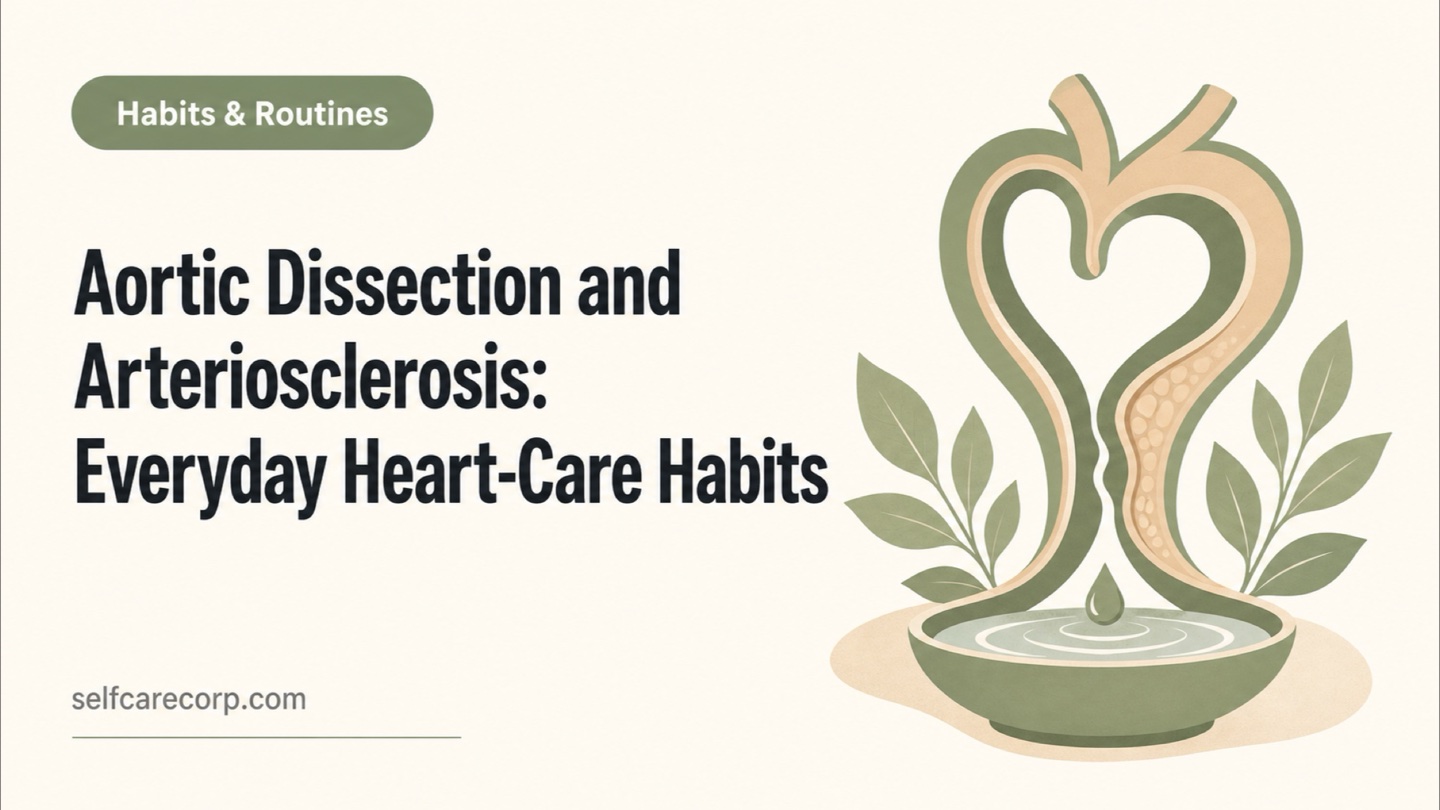
Aortic Dissection and Arteriosclerosis: Everyday Heart-Care Habits
Aortic dissection is a tear in the aorta and a medical emergency. Here's what hardened arteries mean, warning signs to know, and daily habits for heart health.
Table of contents
Aortic dissection is a tear in the inner wall of the aorta, your body's largest artery, and it is a medical emergency — if you or someone near you has sudden, severe chest or back pain, call 911 right away. The phrase "aortic dissection due to arteriosclerotic cardiovascular disease" simply connects that tear to years of stiffening and plaque buildup in the arteries, which the American Heart Association lists among the risk factors. This article is a plain-language, wellness-focused overview for everyday readers who want to understand the terms and build steady heart-healthy habits — it is not medical advice, and it cannot diagnose anything.
As of July 2026, the heart-health targets below come from the American Heart Association and Cleveland Clinic, two groups that publish public guidance for general readers. If you already have a heart condition or specific symptoms, your own doctor's guidance always comes first.
Breaking the phrase down in plain language
Long medical phrases can feel intimidating, but each word is doing a small job. "Arteriosclerosis" means the arteries — the tubes that carry blood away from your heart — gradually stiffen and harden, often as we age. "Atherosclerosis" is a common form of that hardening, where fatty deposits called plaque collect along the inside of the artery walls. So "arteriosclerotic cardiovascular disease" is shorthand for the group of conditions this buildup can lead to, such as coronary heart disease and stroke-related problems.
The "aortic" part points to the aorta, the largest artery in your body, which carries blood from your heart out to everything else. A "dissection" is a tear in the inner layer of that artery wall; blood then pushes into the tear and separates the layers. According to the American Heart Association, atherosclerosis and high blood pressure are among the risk factors that can weaken the aorta over time. The association estimates aortic dissection affects roughly 5 to 30 people per million and describes it as most common between the ages of 50 and 70.
What are the warning signs I shouldn't ignore?
The most commonly reported sign is sudden, severe pain in the chest or upper back that can feel like tearing, ripping, or stabbing — and it is a reason to call 911 immediately, not to wait and see. Cleveland Clinic describes aortic dissection as a medical emergency that can be life-threatening without fast care.
Alongside that sudden pain, Cleveland Clinic lists other signs to take seriously:
- Shortness of breath, or fainting and dizziness
- Pain that spreads down into the belly
- Heavy sweating with a fast, weak pulse
- Stroke-like symptoms, such as weakness on one side of the body or trouble speaking
Knowing these signs is not about diagnosing yourself at home. It is about recognizing an emergency quickly, for you or someone you love, and getting professional help without hesitation.
Everyday habits that support heart and artery health
Here is the encouraging part: the daily habits that support healthy arteries are the same ones you have probably heard about for general wellness. The American Heart Association groups them into a framework it calls Life's Essential 8. As of July 2026, its guidance lists an optimal blood pressure as less than 120/80 mm Hg, and it defines high blood pressure as a top number of 130 to 139 or a bottom number of 80 to 89 mm Hg.
The association also points to about 150 minutes of moderate activity a week — roughly 30 minutes on five days — and 7 to 9 hours of sleep a night for most adults. None of it has to happen all at once. Small, repeatable steps are the whole point, and if planning meals feels like the hard part, it can help to start meal prep small instead of overhauling your whole weekend. Even a simple question like how much water you actually need each day fits into the same steady routine.
Here is how the American Heart Association's Life's Essential 8 translate into everyday language, with one small step for each:
| Habit | What it means | One small step |
|---|---|---|
| Move more | Regular aerobic activity | Work toward 150 minutes a week, about 30 minutes on 5 days |
| Eat well | More vegetables, fruit, and whole grains | Add one vegetable to a meal you already make |
| Avoid nicotine | No smoking or vaping | Pick a quit date and tell one person |
| Sleep enough | 7 to 9 hours for most adults | Set a consistent bedtime, even on weekends |
| Healthy weight | A weight that works for your body | Focus on daily habits, not the scale alone |
| Blood pressure | Optimal under 120/80 mm Hg | Check it and write the numbers down |
| Cholesterol | Healthy blood lipid levels | Ask when you are next due for a blood test |
| Blood sugar | Healthy blood glucose | Watch added sugars in your drinks |
You don't have to master all eight at once. Picking one row and practicing it for a couple of weeks is a realistic way to start.
How can I talk with my doctor about my risk?
Start by bringing two things to your next appointment: your recent blood pressure numbers and what you know about your family history. The American Heart Association suggests that people with risk factors — including high blood pressure, tobacco use, or a family history of aortic aneurysm or dissection — talk with their physician about their risk and whether screening makes sense.
For preventing artery disease more broadly, many clinicians lean on a simple memory aid sometimes called the ABCDS: Aspirin only when a doctor recommends it, Blood pressure control, Cholesterol management, Diabetes management, and Stopping smoking. You don't need to memorize the medical details. What helps is arriving with your questions written down and your numbers in hand, so the conversation starts from real information rather than worry.
A steady, unhurried way to hold all this
Two ideas are worth carrying away. First, aortic dissection is an emergency — sudden, tearing chest or back pain means calling 911, every time. Second, everything else here is a slow, forgiving practice: moving a little more, cooking a little better, sleeping a little longer, and knowing your blood pressure. If you remember one number, let it be 120/80 — the American Heart Association's optimal target as of July 2026 — and treat it as a gentle compass rather than a pass-or-fail test. Caring for your heart is a routine you build one ordinary day at a time.
This article is for general information and self-care education only. It is not medical advice, diagnosis, or treatment. For questions about your health, talk to a qualified healthcare professional.