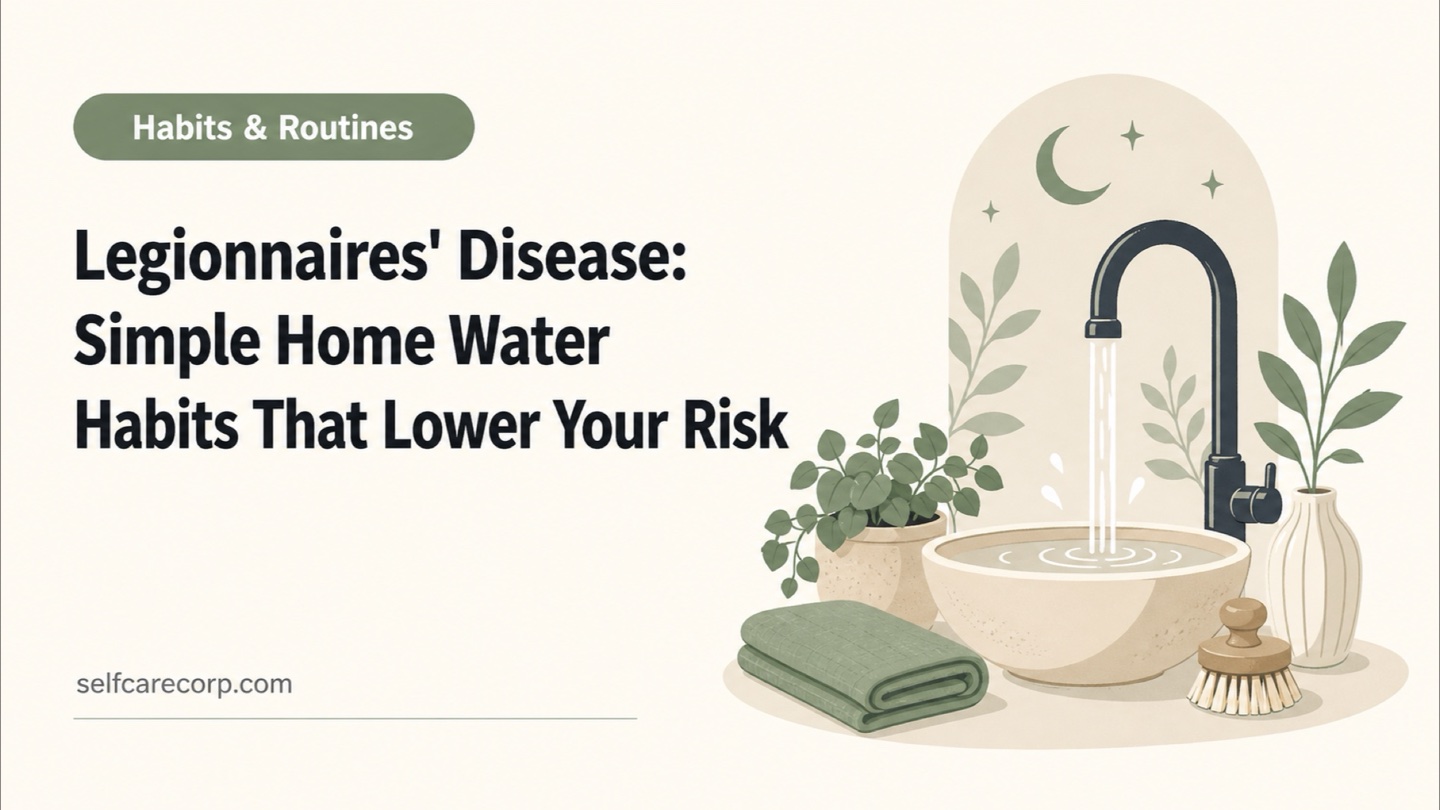
Legionnaires' Disease: Simple Home Water Habits That Lower Your Risk
Legionnaires' disease spreads through inhaled water mist, not person to person. Home habits — flushing taps, heater settings, hot tub care — lower the risk.
Table of contents
Legionnaires' disease is a serious lung infection (a type of pneumonia) caused by a germ called Legionella, and according to the U.S. Centers for Disease Control and Prevention (CDC), people usually catch it by breathing in tiny water droplets rather than from person-to-person contact. The reassuring part for everyday life is that a handful of simple water habits at home — flushing taps after time away, keeping your water heater at a sensible temperature, caring for a hot tub — can lower the chance this bacteria grows where you live. This is a plain-language wellness overview of those home habits, not medical advice or a way to diagnose anything. If you feel unwell, a healthcare provider is the right person to see, and you can read more on the CDC's Legionella pages.
What is Legionnaires' disease, exactly?
It is a lung infection you get from a waterborne bacteria, not a cold you pass around the house. The CDC explains that Legionella lives naturally in fresh water like lakes and streams, where it rarely causes trouble, but it can become a problem when it grows inside building water systems and then spreads in a fine mist that people breathe in. The same germ can also cause a milder, flu-like illness called Pontiac fever. Two details bring a lot of calm here: the CDC notes that people generally do not spread Legionnaires' disease to one another, and that you typically will not catch it just from drinking water — the concern is breathing in mist from things like showers, faucets, and hot tubs.
How does Legionella get into the water at home?
It grows when water sits still and stays warm for a while. The CDC points to conditions that let Legionella multiply: slow-moving or stagnant water, warm temperatures in the range of roughly 77°F to 113°F (about 25°C to 45°C), low levels of disinfectant such as chlorine, and buildup like scale, sediment, or biofilm (the slimy layer that forms inside pipes and fixtures). That is why the risk lives in the small, easy-to-overlook corners of a home — a rarely used guest shower, a garden hose left in the sun, a humidifier tank, or a hot tub that has not been cleaned. Any device that turns water into spray or fine mist is worth a little routine attention.
Everyday home habits that lower the risk
You do not need special equipment — mostly you are keeping water moving, keeping it clean, and keeping mist-making devices in good shape. A few habits do most of the work:
| Around the home | Simple habit |
|---|---|
| Faucets & showers | Run them for a few minutes after they have sat unused for a week or more, such as when you get back from a trip |
| Water heater | Keep it set to at least 120°F (49°C); add anti-scald valves if you worry about burns |
| Hot tub | Keep the disinfectant level right and test it regularly; clean it on schedule |
| Humidifier | Fill with distilled or boiled-then-cooled water; empty and clean it often |
On the water heater, the CDC recommends setting a home heater to at least 120°F (49°C) to limit Legionella growth, while noting that hotter stored water raises the risk of scalding — so households with young children or older adults may want thermostatic (anti-scald) mixing valves near the taps. For hot tubs, the CDC advises checking that free chlorine stays at least 3 parts per million (or bromine at least 4 parts per million) and testing at least twice a day when the tub is in use; inexpensive test strips from a pool-supply shop make this easy. Building these small checks into a weekend rhythm keeps them from feeling like a chore — the same low-effort, stay-safe spirit behind our guide to simple kitchen habits during a cyclospora outbreak.
People who should take extra care
Most healthy adults who breathe in a little mist never get sick, but some groups have a higher chance of a serious infection. The CDC lists the main ones as adults 50 and older, people who currently smoke or used to smoke, those with a weakened immune system, and people with chronic lung conditions. If you or someone you care for falls into one of these groups, the home habits above are worth a little extra consistency — not worry, just steady upkeep. The point is awareness, not anxiety.
When should you talk to a doctor?
Reach out to a healthcare provider if you develop symptoms like fever, cough, shortness of breath, or muscle aches, especially in the days after possible exposure to mist. The CDC describes symptoms of Legionnaires' disease that often begin about 2 to 10 days after contact with the bacteria, and the fever can climb high. Because these signs look a lot like other kinds of pneumonia, this is not something to sort out at home — only a clinician can test for and diagnose it. One practical tip from the CDC: if you used a hot tub or stayed somewhere new in the past two weeks and then feel sick, mention that to your provider, since it can help point them in the right direction.
A calm way to hold all this
Legionnaires' disease sounds scary, and a serious case truly is, but the day-to-day takeaway is gentle: keep water moving, keep it clean, and give your showers, hot tub, and humidifier a little regular attention. None of these steps take long, and together they fold neatly into the kind of small, repeatable self-care habits that quietly protect your health. Awareness plus a few easy routines is enough for most homes — and if symptoms ever show up, you know to check in with a professional rather than guess.
This article is for general information and self-care education only. It is not medical advice, diagnosis, or treatment. For questions about your health, talk to a qualified healthcare professional.