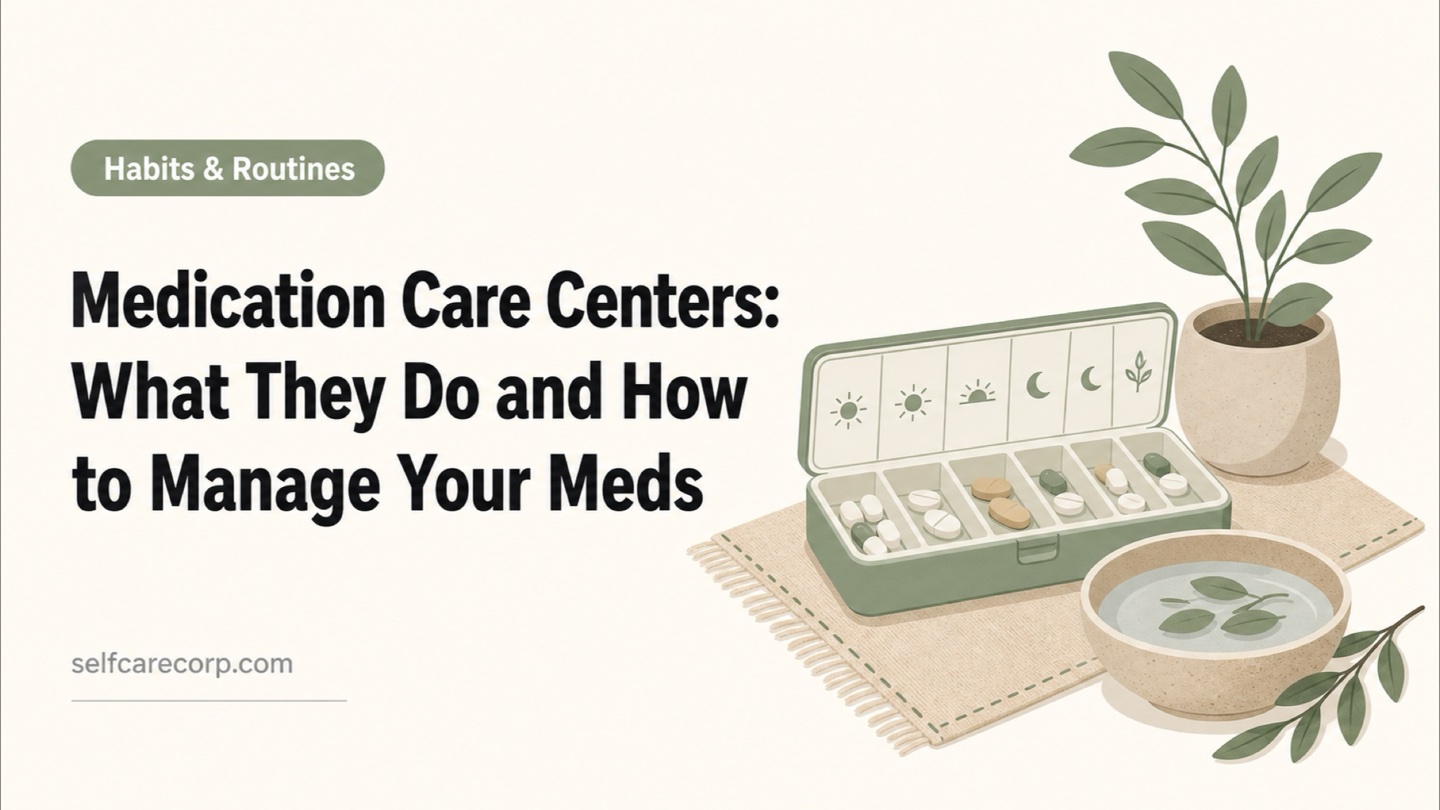
Medication Care Centers: What They Do and How to Manage Your Meds
A medication care center reviews all your medicines together. Here's how Medicare's free program works and simple habits to organize your meds at home.
Table of contents
A medication care center — often called medication management or, under Medicare, Medication Therapy Management (MTM) — is a service where a pharmacist or trained provider sits down with you and reviews all of your medicines together, not one prescription at a time. As of July 2026, the Centers for Medicare & Medicaid Services (CMS) requires Medicare Part D drug plans to offer this service, and for people who qualify it is free. This guide explains, in plain terms, what these services do, who Medicare enrolls, and the simple habits you can use at home to keep your own medicines organized. It is a general self-care overview for readers in the United States, not medical advice — your own pharmacist and doctor are the people who decide what is right for you.
What a medication care center actually is
At its simplest, a medication care center is a place or service — usually a pharmacy — where someone qualified looks at your whole medicine list at once. The goal is to catch problems you might not notice yourself, such as two drugs that should not be taken together, a dose that no longer fits, or a pill you no longer need. According to CMS, a full medication management service is built from five parts:
- A review of all your medicines, including prescription drugs, over-the-counter products, vitamins, and supplements
- A personal medication record you can keep and update
- A written action plan with clear next steps
- A referral to your doctor when something needs a change
- Notes and follow-up so nothing gets lost between visits
You are not being handed new prescriptions here. The pharmacist's job is to make sense of what you already take and flag anything worth a conversation with your doctor.
Who qualifies for Medicare's free program?
Medicare's version of this service is aimed at people who take several medicines for more than one long-term condition. According to CMS rules for Part D plans, eligibility generally rests on three things: having multiple chronic conditions, taking a set number of Part D drugs, and reaching a yearly drug-cost threshold.
CMS caps the medicine count a plan can require at eight — a plan may set its minimum anywhere from two to eight Part D drugs, but no higher. Chronic conditions that plans commonly count include diabetes, high blood pressure, high cholesterol, asthma or COPD (a long-term lung disease), and mental health conditions such as depression. If you meet a plan's rules, CMS requires the plan to enroll you automatically, and you can take part, opt out, or decline any single service without leaving the program. You can read the official description on Medicare's site.
What happens in a medication review
The heart of the service is the Comprehensive Medication Review, or CMR. According to CMS, Part D plans must offer a CMR to eligible members at least once every 365 days. It is an interactive consultation — in person, or by phone or video — with a pharmacist or other qualified provider, and it usually takes about 30 minutes.
Before the appointment, gather every medicine you take, including the ones that are easy to forget: eye drops, inhalers, patches, vitamins, and anything you bought off the shelf. Bring them in their original bottles if you can. Afterward you should leave with two useful things — a personal medication list and, if needed, an action plan spelling out any changes to raise with your doctor.
How can you keep track of your medicines at home?
You do not need to qualify for a formal program to manage your medicines well — a few simple habits do most of the work. Start with a written list and a routine you already have. Here are three tools and what each one is best for:
| Tool | Best for | What it does |
|---|---|---|
| Weekly pill organizer | Once- or twice-daily doses | A compartment for each day, sometimes split into morning, noon, evening, and bedtime |
| Written medicine list | Doctor and pharmacy visits | Name, dose, timing, and what each pill looks like, kept in one place |
| Reminder app | Doses that are easy to forget | A checklist on your phone that nudges you at set times |
A few more habits from MedlinePlus, the National Library of Medicine's consumer health site, are worth building into your week:
- Take your pills at the same time each day by tying them to something you already do — breakfast, or right after you brush your teeth at night. Anchoring a new habit to an old one is the same trick that makes a beginner walking routine stick.
- Store medicines in a cool, dry spot and keep them in their original bottles — not the bathroom, where heat and steam build up.
- Since some pills are meant to be taken with a full glass of water, that is one more reason to keep a simple water habit going through the day.
- If kids or guests pass through your home, use a cabinet that is out of reach or has a simple lock.
- Clear out expired or unused medicines through a pharmacy drop-off box or a community take-back program rather than the trash or the toilet.
You can find the full list on MedlinePlus, and it is a good page to bookmark.
A calmer way to handle your medicines
You do not have to sort all of this out in one afternoon. Pick one step — write your list this week, or fill a seven-day organizer on Sunday night — and let the rest follow. And if your medicines start to feel like a lot to juggle, ask your pharmacist whether you qualify for a medication review. Getting a second set of eyes on what you take is one of the quieter, steadier ways to look after yourself.
This article is for general information and self-care education only. It is not medical advice, diagnosis, or treatment. For questions about your health, talk to a qualified healthcare professional.