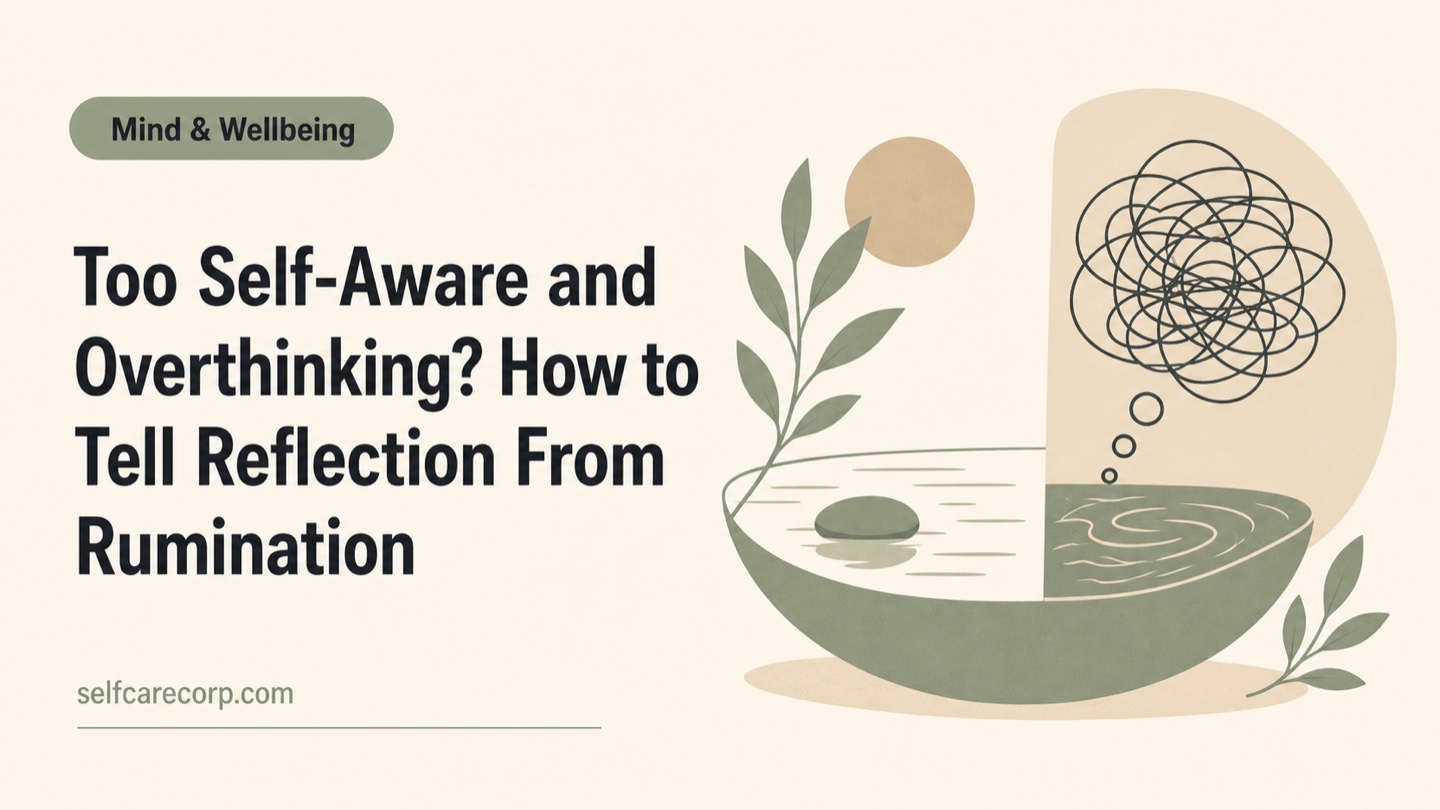
Too Self-Aware and Overthinking? How to Tell Reflection From Rumination
Overthinking often begins as helpful self-awareness. Here's how reflection tips into rumination, the signs to watch for, and simple ways to ease the loop.
Table of contents
Being "too self-aware" usually isn't about knowing yourself too well. It's about your self-attention slipping from reflection into rumination — repetitive, circular thinking about your mistakes, flaws, or worries that loops without ever landing on an action. The American Psychological Association's dictionary of psychology describes rumination as obsessive, repetitive dwelling on the causes and consequences of your distress, and in a 1999 study in the Journal of Personality and Social Psychology, psychologists Paul Trapnell and Jennifer Campbell drew a clean line between reflection, which is curious and open, and rumination, which is anxious and threat-driven. The encouraging part: you don't have to become less thoughtful to feel better. You just have to catch the loop and give it a way out.
This is an everyday self-care guide for people who notice their thoughts spinning, not a diagnosis or a substitute for professional care. If overthinking is steadily eating into your sleep, work, or relationships, the last section points to where to find real support.
Where self-awareness ends and overthinking begins
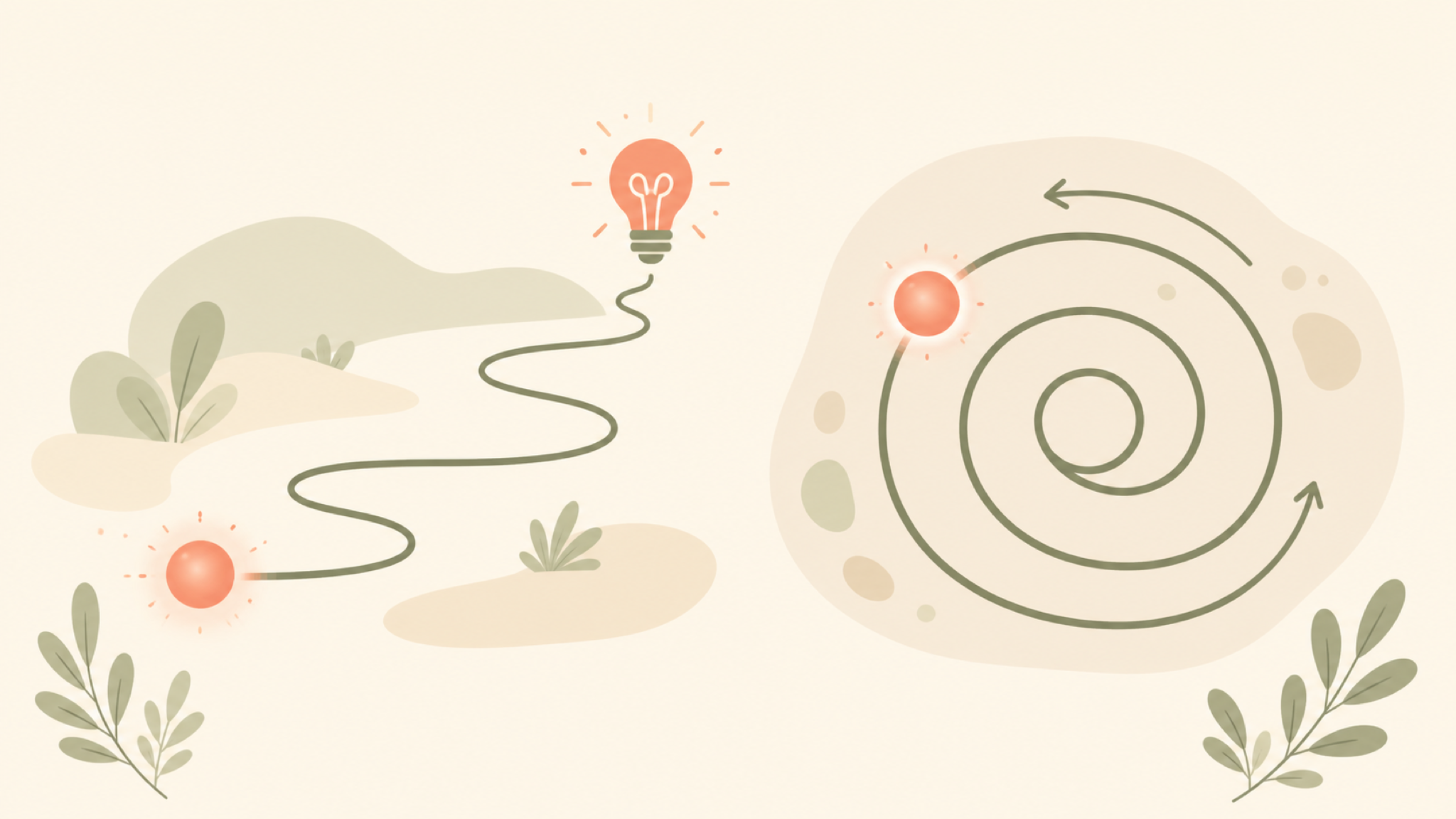
Self-awareness on its own is worth having. Noticing your reactions, learning from a rough conversation, checking in with what you actually feel — that's the useful kind of inner attention. It turns into overthinking when the same self-focus stops teaching you anything and just runs in circles. Trapnell and Campbell's work split private self-focus into two habits: reflection, driven by genuine curiosity about yourself, and rumination, driven by a sense of threat or loss. Reflection tends to leave you clearer. Rumination tends to leave you more stuck.
Here's a quick way to tell them apart in the moment.
| What to check | Healthy reflection | Overthinking (rumination) |
|---|---|---|
| What starts it | Curiosity about yourself | Fear of a threat, loss, or judgment |
| The question you ask | What can I do next? | What's wrong with me? |
| Where it goes | Toward an insight or a decision | In circles, the same thought again |
| How you feel after | Lighter, clearer | More drained and anxious |
| When it ends | You reach a stopping point | Open-ended, hard to stop |
None of these are hard rules. The real test is whether your thinking is moving toward something or just wearing a groove.
Why does being self-aware tip into overthinking?
It tips over when self-attention gets hijacked by a threat: a fear that you got something wrong, that people are judging you, or that a choice will go badly. Yale psychologist Susan Nolen-Hoeksema, who spent her career studying this, described rumination in her response styles theory as a habit of coping with distress by dwelling on it instead of acting on it. Her research linked that habit to longer, heavier low moods and weaker problem-solving, and she wrote about it for general readers in her 2003 book Women Who Think Too Much. There's even a well-documented irony researchers call the self-absorption paradox: past a certain point, turning attention inward to understand yourself actually clouds your read on yourself and makes it harder to take other people's perspective.
In other words, the problem isn't that you look inward. It's that a worried mind keeps handing the same unanswerable question back to you, and looking harder only tightens the knot.
Signs your self-awareness has become rumination
The clearest sign is repetition without resolution. A few markers worth noticing in yourself:
- You replay the same conversation or decision more than a handful of times and reach no new conclusion.
- Your inner questions are mostly "why" — why am I like this, why did I say that — rather than "what can I do now" or "how do I handle it."
- The loop shows up in your body: a tight jaw, shallow breathing, or lying awake at 2 a.m. running the same tape. These often overlap with the everyday signs of a body under too much stress.
- You feel more drained and anxious after thinking, not lighter or more decided.
One or two of these on a hard day is ordinary. A steady pattern most days is the cue to change how you respond, not to think harder about why you overthink.
How do you stop overthinking without shutting off self-awareness?
You give the thinking a container and an exit instead of trying to force it quiet. Willpower rarely wins a staring contest with a worry, so these tools work by redirecting attention rather than fighting it.
- Worry time. The NHS's Every Mind Matters guidance suggests setting aside a short daily window — around 10 to 15 minutes — to write your worries down and look for solutions, so they stop leaking into the rest of your day. When a worry turns up off-schedule, jot it on a note and save it for the window.
- The worry tree. The same NHS guidance uses a simple sort: can you actually do something about this worry? If yes, act now or schedule the action. If it's hypothetical and outside your control, that's your cue to practice letting it go rather than solving it.
- 5-4-3-2-1 grounding. Name five things you can see, four you can touch, three you can hear, two you can smell, and one you can taste. It pulls attention out of your head and back into the room.
- Slower breathing. Breathe in for a count of four and out for six to eight, for four or five rounds. A longer exhale nudges your nervous system toward calm.
- Change your position. Stand up, step outside, or walk around the block. Moving your body is one of the simplest ways to interrupt a mental loop.
Not sure which to reach for? Match the tool to the moment.
| When the loop looks like... | Try this first |
|---|---|
| A decision you keep replaying | The worry tree: act, schedule, or release it |
| Worry leaking into your whole day | A 10 to 15 minute daily worry time |
| Spiraling right now, body tense | 5-4-3-2-1 grounding, then slower breathing |
| The same regret at 2 a.m. | Write it down and park it until tomorrow |
Turning rumination back into useful reflection
The goal isn't to silence self-awareness. It's to point it somewhere useful. The fastest reframe is swapping your questions: trade "why" for "what" and "how." "Why do I always mess this up" keeps you circling; "what would I do differently next time" gives your mind a task and an ending. Writing helps here too, because a worry on paper is easier to finish than one in your head. If a blank page feels like too much, building a small daily writing habit gives rumination a structured place to land — a few honest lines, then one next step you can actually take.
It also helps to set a stopping point on purpose. Decide in advance that you'll think a problem through once, write down the best next action, and then leave it until something changes. Reflection has an ending; rumination doesn't, so you supply one.
When to reach out for more support
Self-care tools handle everyday overthinking well, but they aren't meant to replace professional help. If the loops have hung on for weeks and are wearing down your sleep, appetite, focus, or relationships, that's a good reason to talk to your doctor or a therapist — not a sign you've failed at managing your own mind. In the UK, the NHS offers free, CBT-based support through its Talking Therapies service, and many places have similar low-cost options. Reaching out early tends to make the work shorter, not longer.
Being reflective is a strength. It only works against you when it forgets to stop. Catch the loop, give it a container and an exit, and your self-awareness goes back to doing what it does best: helping you understand yourself, then letting you get on with your day.
This article is for general information and self-care education only. It is not medical advice, diagnosis, or treatment. For questions about your health, talk to a qualified healthcare professional.