Signs of Low Self-Worth and How Self-Compassion Helps
Harsh self-talk, deflected praise, chronic self-doubt: the common signs of low self-worth, and how self-compassion helps you respond to yourself more kindly.
Table of contents
Low self-worth tends to show up as a quiet running commentary that you are not quite good enough: harsh self-criticism, waving away compliments, and treating an ordinary mistake as proof of a flaw instead of a normal part of being human. One of the most researched ways to loosen that pattern is self-compassion, which simply means treating yourself with the kindness you would offer a friend who was struggling. Psychologist Kristin Neff, who developed the widely used Self-Compassion Scale, describes it as a skill built from three parts you can practice, not a personality trait you either have or you don't. This piece is for everyday readers who want to spot the signs in themselves and try a few gentle steps. It is not a diagnosis or a stand-in for professional care.
Self-worth and self-esteem are not the same thing
These two words often get swapped, but they lean on different things. Self-esteem is how positively you rate yourself, and it usually rides on outside markers: a good review at work, a compliment, a number on the scale. Self-worth is the steadier sense that you have value as a person even when those markers dip. When your sense of value is tied to constant achievement or approval, psychologists call it contingent, meaning it climbs and drops with your latest win or setback. Studies of contingent self-worth link that up-and-down pattern to more stress and lower mood, because a bad day starts to feel like a verdict on who you are. In plain terms, it is the gap between 'I did badly on this' and 'I am a failure.'
What does low self-worth look like day to day?
It usually looks like a cluster of small habits rather than one dramatic feeling. The common thread is a harsher inner voice for yourself than you would ever use with someone you love.
- Harsh self-talk over ordinary slip-ups: calling yourself stupid, lazy, or a mess for things you would forgive in anyone else.
- Deflecting praise and good news while replaying a single criticism for days.
- Setting the bar so high that nothing you finish feels like enough, a pattern many people recognize as perfectionism.
- Struggling to say no or hold a boundary, and leaning on other people's approval to feel steady.
- Assuming you are the exception: everyone else seems to have it together, so your struggles must mean something is wrong with you.
That last habit, looping over your shortcomings, can slide from honest reflection into rumination, where the same thoughts churn without going anywhere. The difference is worth knowing, and it helps to read up on how to tell reflection from rumination before you assume all that self-examination is doing you good.
How self-compassion helps
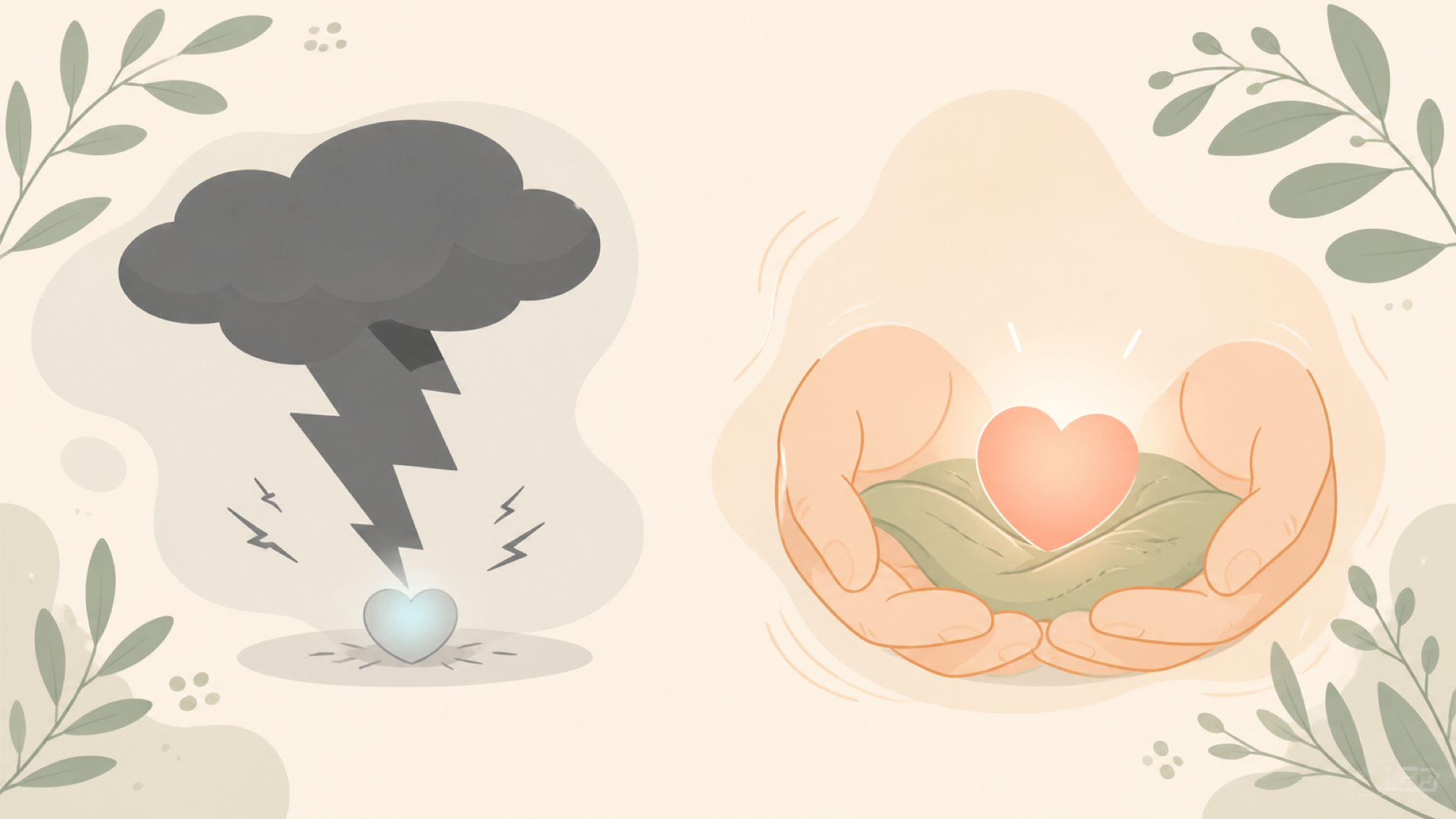
Self-compassion works by changing your relationship to a hard moment, not by pretending the moment is fine. Kristin Neff, whose research at the University of Texas at Austin helped define this field, breaks the skill into three parts that answer three common traps of low self-worth.
- Self-kindness instead of self-judgment: meeting a mistake with warmth rather than an attack.
- Common humanity instead of isolation: remembering that failing and feeling inadequate are part of every human life, not proof that you alone are broken.
- Mindfulness instead of over-identification: noticing a painful feeling and naming it, without being swept away or blowing it up into the whole story of who you are.
In Neff's research, people who score higher in self-compassion tend to report less anxiety and depression and more resilience after setbacks, and she argues they get there without the downsides she ties to chasing self-esteem, such as harsh social comparison or a sense of worth that depends on being better than other people. Neff shares the scale and a set of free exercises on her site, self-compassion.org. It is also worth clearing up a common worry: self-compassion is not letting yourself off the hook. Neff's work finds that self-compassionate people are often more willing to take responsibility and try again, because a setback stops feeling like a threat to their entire identity.
How do you actually practice self-compassion?
Start small and treat it as a skill you rehearse, not a mood you wait around for. Two of Neff's exercises take only a few minutes.
The first is to talk to yourself like a friend. Bring to mind how you would respond to someone you care about in your exact situation, notice the words and the gentler tone you would use, then offer that same response to yourself. Neff describes this as one of the most reliable ways to step out of self-attack.
The second is the self-compassion break, a short three-line practice that maps onto the three parts above. In a hard moment, first name it ('this is a difficult moment'), then widen it ('difficult moments are part of every life'), then offer yourself a kind phrase ('may I be gentle with myself'). The Greater Good Science Center at UC Berkeley hosts a free guided version at greatergood.berkeley.edu.
A few smaller cues help the habit stick:
- Catch absolute words like 'always' and 'never.' The thought 'I always ruin this' is rarely literally true, and softening it to 'this went badly today' is both more accurate and less punishing.
- Add a small physical anchor, like a hand on your chest or one slow breath, to steady the moment before you answer yourself.
- Keep two or three kind phrases saved in your notes app, worded so they actually sound like you rather than a wall poster.
You probably won't feel warm toward yourself on the first try, and that is normal. The practice is the repetition, built the way you would build any small routine: a minute at a time, and especially on the days it feels least natural.
When it might be worth reaching out for more support
Self-compassion is a daily practice, not a treatment. If low self-worth comes with lasting low mood, losing interest in things you used to enjoy, or any thoughts of harming yourself, treat that as a signal to talk with a doctor or a mental health professional. A therapist can help with patterns that feel stuck, and self-compassion tends to work well alongside that kind of support rather than in place of it. If your inner critic also feeds a coping habit you would like to change, our guide to evidence-based steps and when to get help shows where to start. Being kind to yourself and asking for help are not opposites. Most of the time, they are the same move.
This article is for general information and self-care education only. It is not medical advice, diagnosis, or treatment. For questions about your health, talk to a qualified healthcare professional.