How to Prevent Child Drowning: Building Layers of Protection
The CDC calls drowning the leading cause of death for kids 1–4. Prevention takes layers: close supervision, four-sided fencing, life jackets, and swim skills.
Table of contents
- Why child drowning is quieter and faster than most parents picture
- What does "layers of protection" actually mean?
- How closely do I need to watch my child near water?
- Barriers and gear that make a real difference
- Swim skills, CPR, and staying steady if something goes wrong
- Turning water safety into a family habit
The most effective way to prevent child drowning is to stop relying on any single safeguard and instead stack a few together: close supervision, a physical barrier like a fence, a proper life jacket, swim skills, and knowing CPR. The CDC's drowning prevention pages list drowning as the leading cause of death for children ages 1 to 4, and report that most of those drownings happen in home swimming pools. A handful of practical habits, layered together, close most of the gaps where these tragedies slip through.
As of July 2026, the American Academy of Pediatrics (AAP) recommends exactly this approach, which it calls "layers of protection," because no single method prevents every drowning. A recent AAP evidence review on drowning prevention, discussed by CNN wellness medical expert Dr. Leana Wen, an emergency physician, makes the same case: overlapping safeguards save lives precisely because any single one can fail. This guide is for everyday families watching young children around home pools and open water in the United States. It is not medical advice or a replacement for your pediatrician; think of it as a calm checklist you can actually keep.
Why child drowning is quieter and faster than most parents picture
Drowning rarely looks like the splashing and shouting we see in movies. The CDC notes that drowning is often silent and can happen in seconds, so a child can slip under while the adults nearby hear nothing at all. That is exactly why "just keeping an eye out" is not enough on its own.
Where it happens matters too. The CDC reports that among children ages 1 to 4, most drownings occur in home swimming pools, usually when a child reaches the water during a gap in supervision: a screen door left open, or a few minutes when each adult assumed the other was watching. Across all ages up to 19, the CDC estimates that around 900 children and teens die from unintentional drowning in the US each year, an average of about three a day. According to the AAP report as reported by CNN, 1,075 children and adolescents younger than 20 died from unintentional drowning, including watercraft-related incidents, in 2024. Those numbers are heavy, but they point to something hopeful. Most cases involve a single moment of access that a barrier or a designated watcher can close.
What does "layers of protection" actually mean?
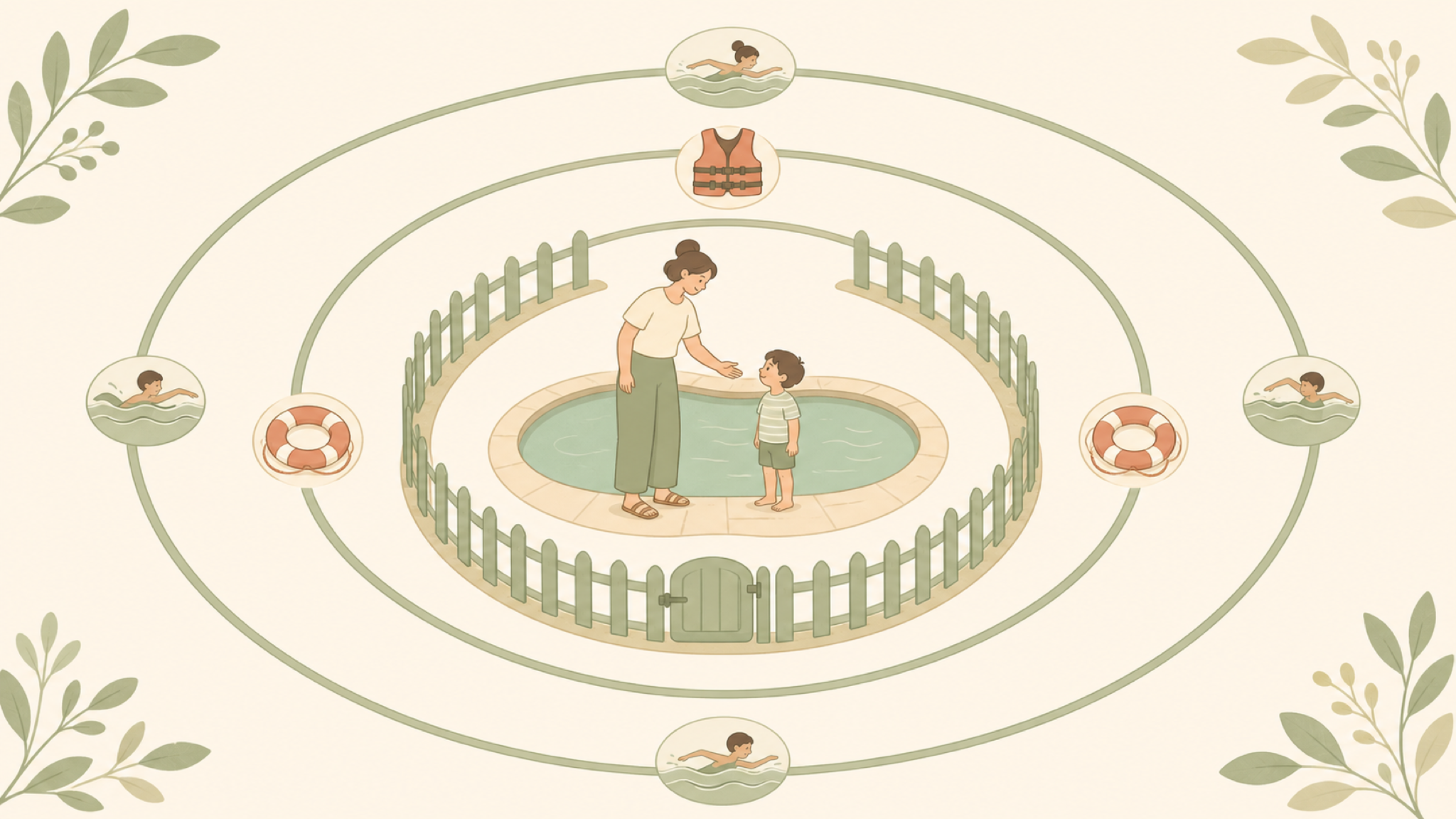
It means no single safeguard carries the whole job. The AAP is clear that no one method prevents every drowning, so the goal is to overlap several safeguards. If one fails, another still stands between your child and the water.
Here is how the main layers compare, and where each one earns its place:
| Layer | What it guards against | Where it matters most |
|---|---|---|
| Close supervision | A child reaching water unnoticed | Every setting, especially pools and tubs |
| Four-sided fencing | Unsupervised access to a home pool | Backyard and home pools |
| Life jackets | Going under in deep or open water | Boats, lakes, rivers, ocean |
| Swim skills | Panic and fatigue in the water | Ongoing, as kids grow |
| CPR knowledge | The delay before help arrives | Any water emergency |
You do not need every layer in place before your child can enjoy the water. Start with the two that fit your situation today, usually supervision plus a barrier or a life jacket, and add the rest over time.
How closely do I need to watch my child near water?
Close enough to touch. For babies, toddlers, and any child who is not yet a strong swimmer, the AAP describes "touch supervision," which means staying within arm's reach so you can reach the child the instant their head goes under. Being in the same yard is not the same as being within arm's reach.
With a group of adults around, it helps to name a "water watcher": one person whose only job, for a set stretch of time, is watching the water. The AAP describes this supervision as close, constant, and attentive, which rules out scrolling, side conversations, and stepping inside "just for a second." Phones are the big one, so put yours away or hand it to someone else. Take turns in short shifts so the watcher stays fresh, and pass the role clearly out loud, saying something like "you've got the water," so there is never a gap where everyone assumes someone else has it.
Barriers and gear that make a real difference
Supervision is the layer you carry everywhere, but a physical barrier keeps working in the seconds you look away. For home pools, the AAP and CDC recommend four-sided isolation fencing at least 4 feet (about 1.2 meters) high that separates the pool from the house and the rest of the yard, fitted with a self-closing, self-latching gate a small child cannot open. "Four-sided" is the key part. A fence that uses the house as one of its sides still lets a child walk out a back door straight to the water.
For boats, lakes, rivers, and the ocean, a well-fitted life jacket is the layer that keeps a small body at the surface. The CDC and US Coast Guard point out that air-filled or foam toys such as water wings, arm bands, "floaties," and pool noodles are not safety devices; they can slip off, lose air, or give everyone a false sense of security. Choose a US Coast Guard-approved life jacket sized to your child's weight, and check that it is fully fastened and snug. One simple fit check: lift the child gently by the shoulders of the jacket, and if it slides up past their chin or ears, it is too big.
Swim skills, CPR, and staying steady if something goes wrong
Swim lessons are a layer, not a force field. The AAP recommends that most children start swim lessons by about age 4, when nearly all are developmentally ready, and earlier for families with a home pool or who live near water; the right timing still depends on the individual child and a conversation with your pediatrician. The AAP is also clear that swim lessons reduce the risk of drowning but do not eliminate it, so even a confident young swimmer still needs supervision and barriers, because skills fall apart under panic and fatigue.
The final layer is what happens in an emergency. Taking a CPR course through a group like the American Red Cross means a caregiver can act in the minutes before paramedics arrive, and simply knowing you are prepared takes some of the fear out of pool days. If a child goes missing near water, check the water first. In an emergency, get the child out, call 911, and begin the care you were trained to give. That steadiness is worth building ahead of time; the same calm-under-pressure mindset that helps you stay grounded during a health scare is easier to reach when you have practiced it before you need it.
Turning water safety into a family habit
None of this has to feel overwhelming. Pick the layers that fit your summer, set them up once, and let the rest run on autopilot: gate latched, phone down, watcher named, life jackets on before you reach the dock. If you plan lake and beach days the way you might check conditions before you head outside, water safety stops being a worry you carry and becomes a few small habits you barely notice, the quiet kind of care that lets everyone actually relax by the water.
This article is for general information and self-care education only. It is not medical advice, diagnosis, or treatment. For questions about your health, talk to a qualified healthcare professional.