Singing Bowl Meditation for Beginners: How to Start at Home
Singing bowl meditation for beginners: what you need, how to strike and circle the bowl, and a simple 10-minute practice you can try at home today.
Table of contents
Singing bowl meditation is a gentle relaxation practice: you play a metal or crystal bowl, then rest your attention on the sound and the quiet that follows it. To try it at home you really only need three things — a bowl, a striker to play it with, and about ten minutes somewhere quiet. You don't need any experience, and a lot of people find it easier than silent meditation because the sound gives your mind something to hold onto. A 2017 study in the Journal of Evidence-Based Complementary and Alternative Medicine, led by Tamara Goldsby, reported that participants felt calmer after a single singing bowl session. This is a guide to everyday relaxation for total beginners, not a treatment for any medical condition, so think of it as a small habit rather than a cure.
What a singing bowl actually is
A singing bowl is a bowl-shaped bell you play from the outside, either by tapping it once or by running a mallet around its rim. There are two common kinds. Metal bowls, often called Tibetan or Himalayan bowls, are made from a blend of metals and give a warm tone with several notes layered inside it. Crystal bowls are made from quartz and give a clearer, higher, more piercing sound.
For a first bowl, metal is the more forgiving choice. Quartz is easier to crack if you knock it, and a metal bowl will still hold a tone even when your technique is uneven, which matters a lot in the early days. Size changes the pitch too: smaller bowls tend to sound higher and brighter, larger ones lower and deeper. Neither is more "correct" — pick the tone that feels calming to your own ear.
What do you need to get started?
Not much, which is part of the appeal. You need a bowl, a striker (also called a mallet), somewhere comfortable to sit, and a quiet stretch of ten minutes. A cushion helps but isn't essential.
The striker usually has a wooden core, and one end is wrapped in leather or suede. That wrapped end is for circling the rim to make the long hum. The bare wooden end, or a separate soft-headed striker, is for tapping the side to make a single chime. If your bowl came as a set, you almost certainly have everything you need already. There's no need to buy an app, a subscription, or anything extra to begin.
Two ways to play the bowl
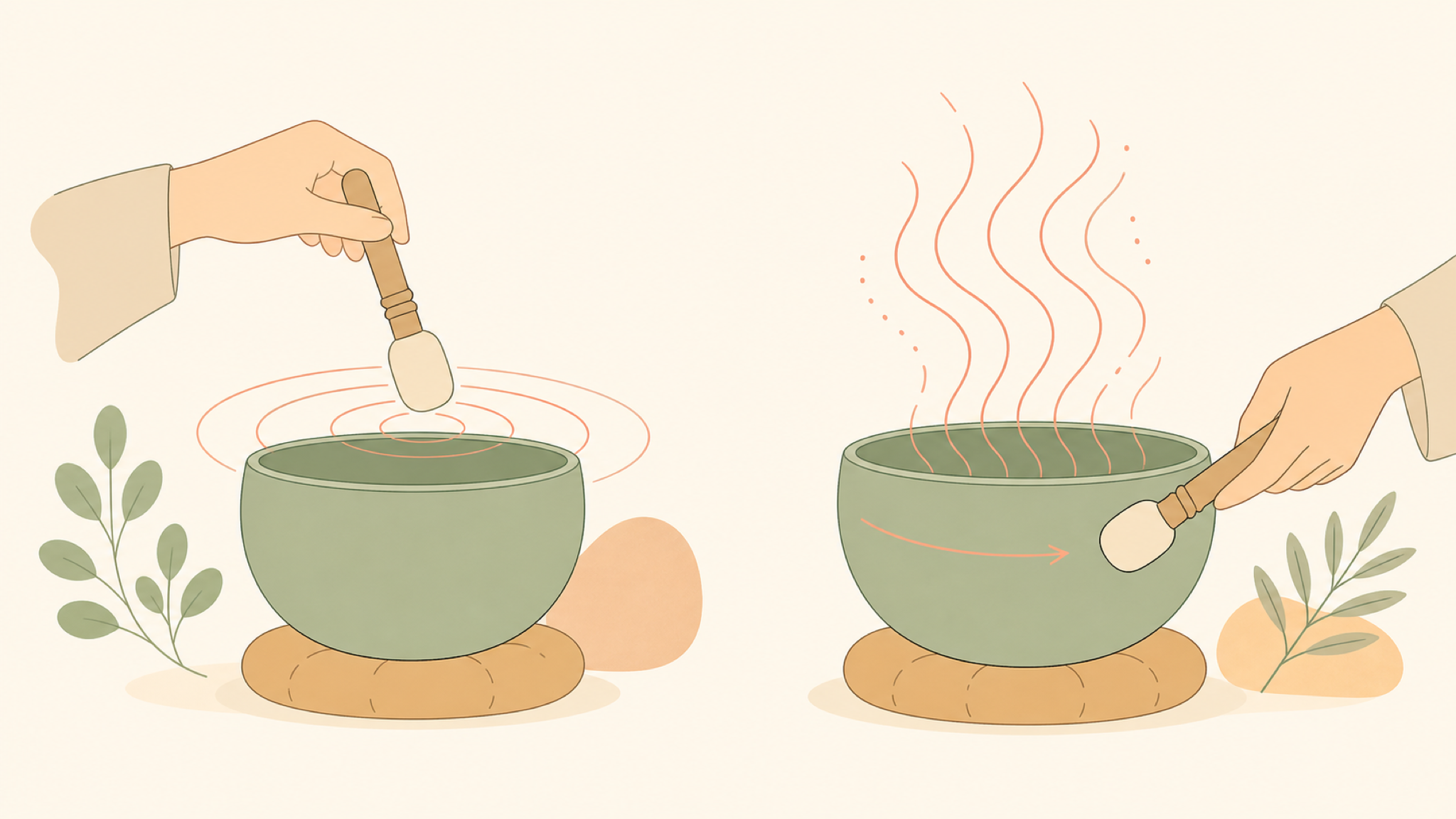
There are two basic techniques, and beginners usually start with the first one because it works on the very first try.
| Technique | How to do it | The sound it makes | Good for |
|---|---|---|---|
| Striking | Tap the side of the bowl once with the striker, then wait | A single bell-like chime that slowly fades to silence | Day one; an easy focus point |
| Rimming | Press the wrapped mallet to the outer rim and move it slowly in a circle | A long, continuous hum | A steady drone, once you've practiced a little |
With striking, the important part is what happens after the tap: let the sound ring out all the way and listen until it fully fades before you strike again. That fading tail, and the silence underneath it, is where the meditation actually lives. Rimming is trickier. You keep even pressure and a slow, steady speed, and it often takes a few sessions before the hum holds instead of squeaking. If it squeaks at first, slow down and press a touch harder rather than moving faster.
A simple 10-minute beginner practice
Here's a short routine you can follow start to finish. If ten minutes feels long, five is completely fine.
- Get settled (1 minute). Sit with a straight but relaxed back. Rest the bowl flat on a cushion or on your open palm, keeping your hand level so the bowl sits steady.
- Take a few breaths (1 minute). Breathe slowly in and out a few times to arrive. Nothing fancy — just notice you're here.
- Strike once and listen (5 minutes). Tap the bowl gently and follow the sound with your attention as it rises, holds, and fades. When it's gone, sit in the quiet for a moment, then strike again. Let your mind wander to the sound each time it drifts.
- Try the rim, optional (2 minutes). If you'd like, circle the rim slowly to make the longer hum and rest your attention there instead.
- Close in silence (1 minute). Set the striker down and sit quietly for a minute before you get up.
If silent meditation has never quite clicked for you, the sound can be an easier way in. Once this feels natural, you might enjoy pairing it with a simple daily mindfulness practice.
Does it really help you relax?
The research is small but genuinely encouraging. In the 2017 study led by Tamara Goldsby, published in the Journal of Evidence-Based Complementary and Alternative Medicine, 62 people with an average age of about 50 took part in a singing bowl sound meditation. Afterward, participants reported significantly less tension, anger, fatigue, and low mood, and the authors noted that people who were new to this kind of meditation showed the largest drop in tension. You can read the summary on the study's PubMed record.
A couple of honest caveats. This was one observational study measuring how people felt right after a session, not proof that singing bowls treat anxiety or depression over time. So it's fair to say a session can help you feel calmer in the moment, and it's a low-cost, low-tech thing to try. It isn't a replacement for medical care. If you're dealing with an ongoing health concern, keep working with a professional and treat this as one small piece of your self-care, not the whole answer.
Making it stick
Like any calm habit, this works best when it's small and regular rather than long and occasional. Playing the bowl for five to ten minutes at the same time each day — first thing in the morning or right before bed — gives it a natural anchor so you don't have to decide anew each time. Keeping the bowl somewhere you'll see it, like a bedside table, is a quiet reminder on its own.
On a hard day, you don't even need the full routine. One strike and three slow breaths can work as a quick reset when pressure builds. The goal isn't to do it perfectly. It's to give yourself a few honest minutes of quiet, and the sound is just there to help you find them.
This article is for general information and self-care education only. It is not medical advice, diagnosis, or treatment. For questions about your health, talk to a qualified healthcare professional.