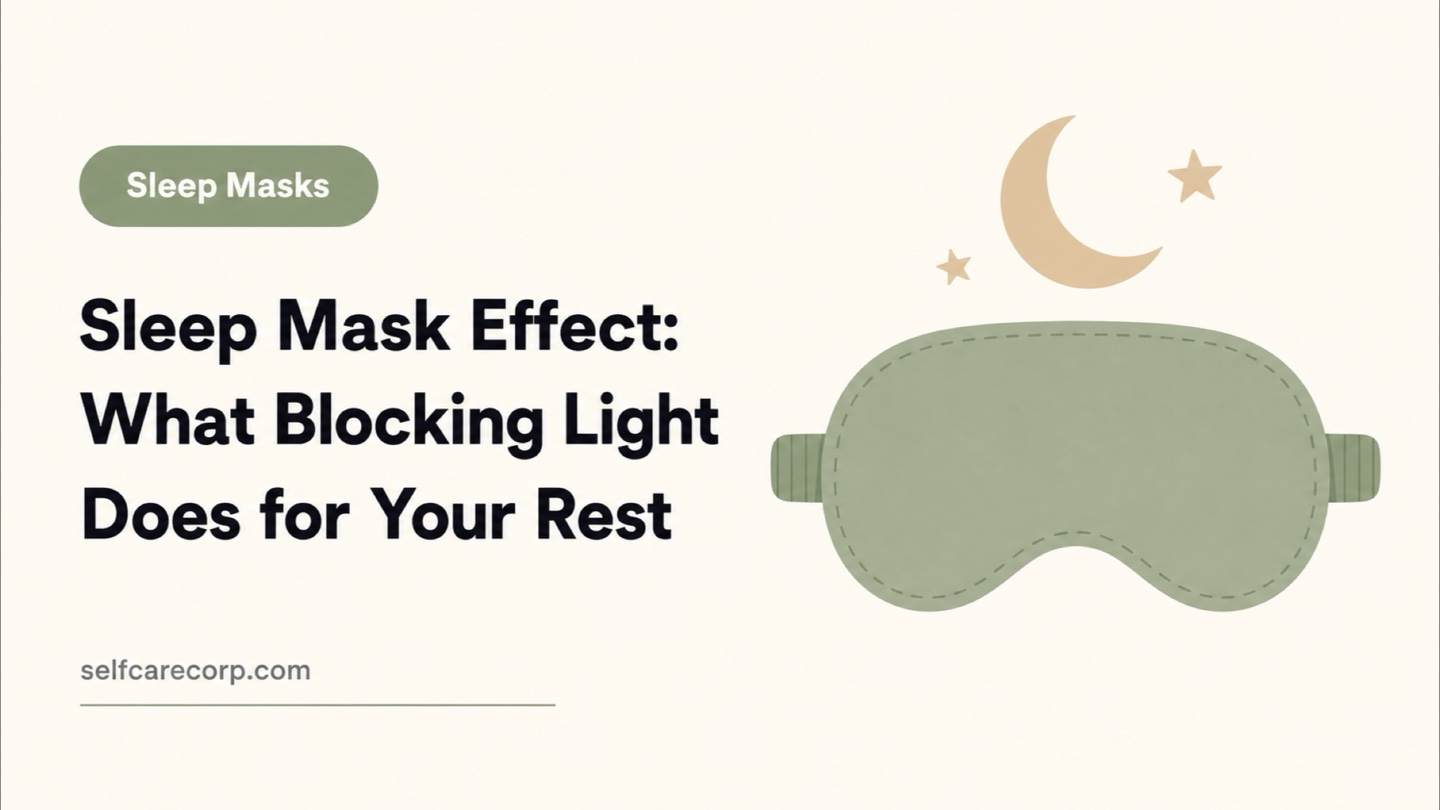
Sleep Mask Effect: What Blocking Light Does for Your Rest
A sleep mask blocks light so your brain can wind down. Here's what research says it does for your rest and focus, and how to pick one that works.
Table of contents
A sleep mask has one job: it keeps light off your closed eyes all night. That single change can steady your sleep because light, even a faint amount, tells your brain to stay alert by holding back melatonin, the hormone that winds you down for rest. Researchers writing in the journal Sleep found that people who wore an eye mask overnight were a little quicker and sharper the next day. So the honest answer is that a good mask won't knock you out like a pill, but it can make your nights darker and your mornings clearer, especially if your bedroom never gets fully dark.
This guide covers what a light-blocking sleep mask does for everyday sleepers and how to choose one. It isn't medical advice or a treatment for a diagnosed sleep condition; if your sleep trouble drags on for weeks, that's worth raising with a clinician.
What a sleep mask actually does
Your eyelids are thin, and light slips right through them. A streetlamp outside the window, a partner's reading lamp, the glow of a charger, or an early summer sunrise can all reach your eyes while they're shut. A mask closes that gap and gives you the kind of darkness that heavy curtains sometimes miss.
Darkness matters because your body runs on a roughly 24-hour internal clock, called the circadian rhythm, that decides when you feel sleepy and when you feel awake. Darkness is the main signal that tells this clock it's night. Take that signal away, even partly, and your brain gets a mixed message about whether it's time to rest.
Does a sleep mask really improve sleep?
For many people, yes, though the effect is gentle rather than dramatic. Researchers led by Viviana Greco reported in the journal Sleep that adults who wore an eye mask for several nights reacted slightly faster and learned new information better the next day. In their reaction-time test, mask-wearers averaged about 310 milliseconds against roughly 316 without the mask, a small gap but a steady one across dozens of participants. The memory edge tracked with more time in slow-wave sleep, the deep stage that helps lock in what you learned.
It's fair to stay skeptical, and some scientists are. A 2023 reanalysis in the same journal argued the gains were small and not consistent across every measure. A mask is no shortcut to perfect sleep. The case gets stronger in bright settings: studies of hospital patients, whose rooms stay lit around the clock, found that eye masks, often paired with earplugs, raised sleep-quality scores and cut how often people woke up. If your room is already pitch black, a mask may add little. If it isn't, that's where it earns its keep.
Why darkness helps: the melatonin link
Melatonin is the hormone that eases you toward sleep, and your brain releases it freely only in the dark. Light, especially the bluish light from phones, TVs, and LED bulbs, tells your brain to hold that hormone back. A 2011 study in the Journal of Clinical Endocrinology & Metabolism found that, next to dim light, ordinary room light before bed pushed melatonin's release later and shortened how long it stayed high by around 90 minutes. That's a real chunk of your wind-down window.
A mask can't undo the light you stare at before bed, so it works best alongside a darker evening: dimming screens, lowering lamps, and letting your eyes settle. Think of the mask as cover for the hours after you drift off, when a sunrise or a hallway light might otherwise nudge you awake too soon.
How do I pick a sleep mask that works?
Look for full coverage and a fit that stays put without pressing on your eyes. The mask should seal light along your nose and cheeks, not just across the eyelids, because that side gap is where most stray light sneaks in. Past that, the right style comes down to how you sleep.
| Mask type | Best if you | Watch out for |
|---|---|---|
| Flat, soft fabric | Want something light and packable | Pressure on the eyelids; can slip |
| Contoured (3D) | Dislike fabric touching your lashes | Bulkier and usually pricier |
| Weighted | Like gentle pressure to relax | Feels warmer; heavier to pack |
| Strap-around | Move around a lot in your sleep | Straps can tangle in long hair |
A few practical notes: an adjustable strap beats a tight band that leaves marks or slides off by morning. Cotton or silk breathe better if you tend to run warm. And a mask pairs well with earplugs when noise is also keeping you up, since the two together handle two of the most common sleep disruptors at once. If you're already fine-tuning your routine around light and timing, such as during the clock shifts that throw off so many people's rest twice a year, a mask is one of the cheapest tools to keep on hand.
Making it a habit that sticks
Give a mask more than one night before you judge it. The first evening can feel odd, a little pressure and an unfamiliar snugness, and most people stop noticing it within a week. Keep it on your nightstand so reaching for it turns automatic, wash it about as often as you'd wash a pillowcase, and watch how you feel in the morning rather than how deeply you think you slept. For a habit that costs so little, a darker, steadier night is a fair return. The Sleep Foundation puts a dark bedroom near the top of its advice for better rest, and a mask is the most portable way to get there.
This article is for general information and self-care education only. It is not medical advice, diagnosis, or treatment. For questions about your health, talk to a qualified healthcare professional.