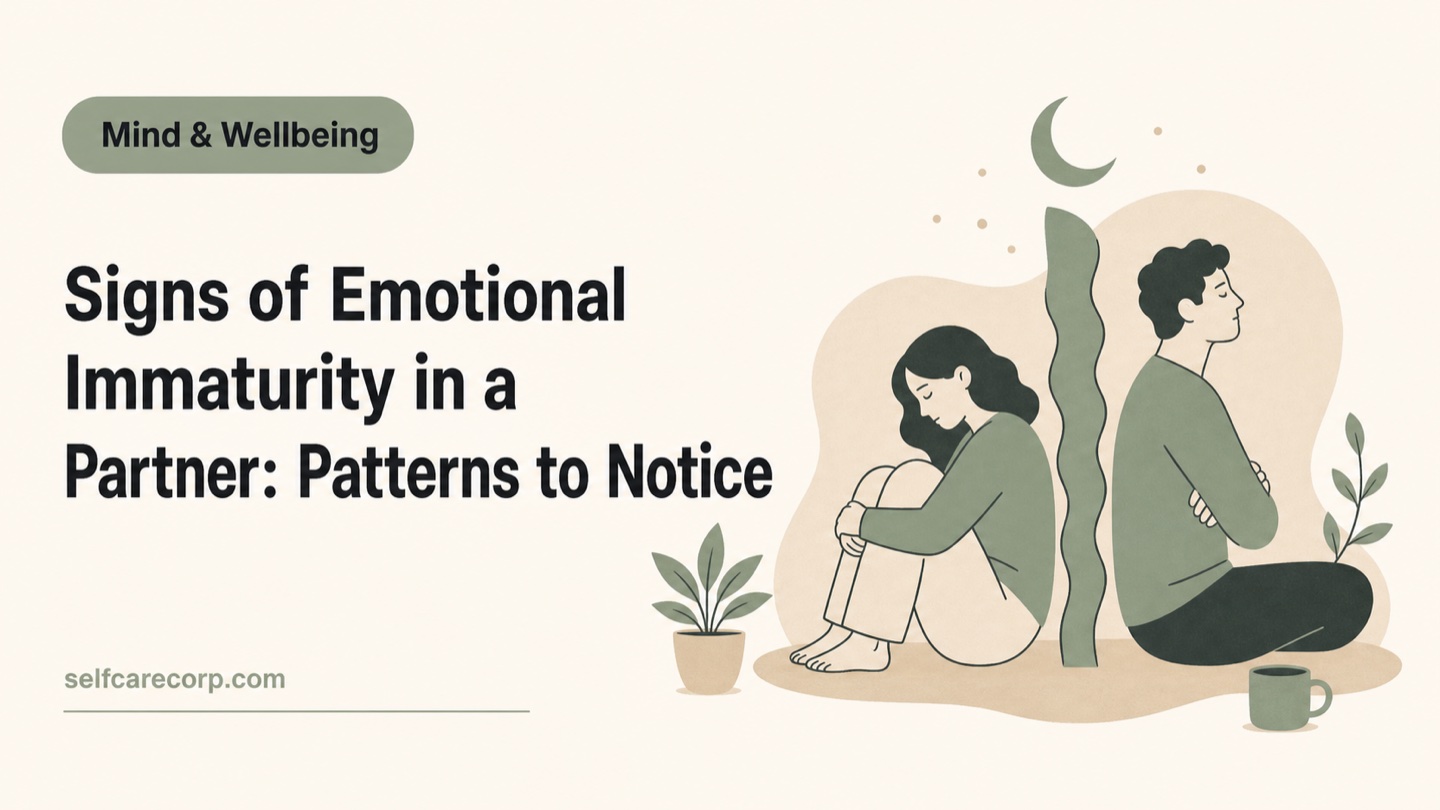
Signs of Emotional Immaturity in a Partner: Patterns to Notice
Emotional immaturity in a partner is a steady pattern of big reactions, blame-shifting, and thin empathy. How to spot it and protect your wellbeing.
Table of contents
Emotional immaturity in a partner shows up as a repeated pattern: big reactions to small problems, trouble owning a mistake, and little room for how you feel. The American Psychological Association's Dictionary of Psychology describes emotional immaturity as a tendency to express emotions without restraint or out of proportion to the situation. It is not a medical diagnosis, and one hard week does not make anyone immature. This piece is about noticing steady patterns in an adult relationship so you can care for your own wellbeing, not about labeling your partner or deciding for you whether to stay.
What emotional immaturity really means
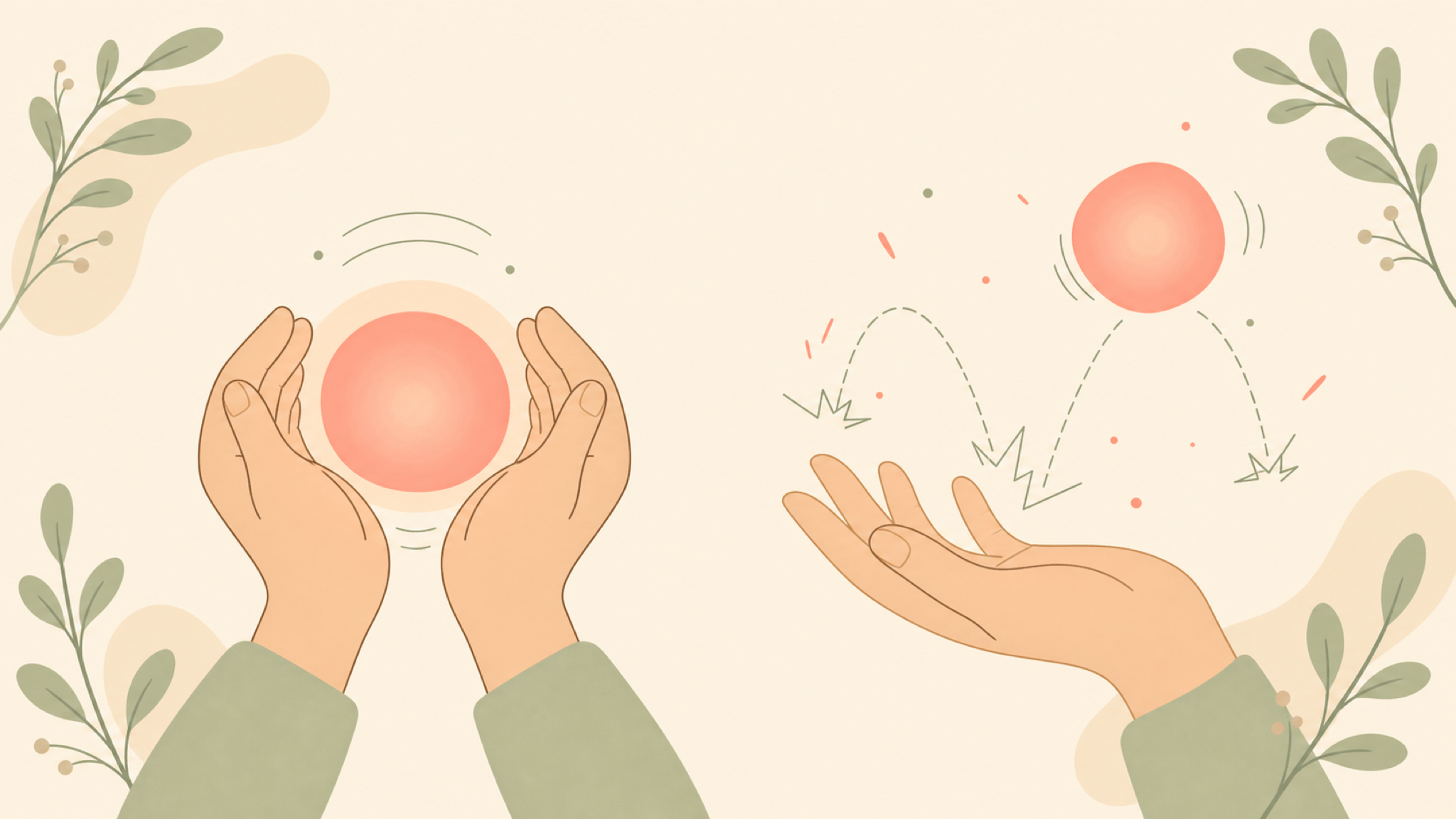
Emotional maturity is the ability to handle feelings in a steady, age-appropriate way: noticing them, sitting with them, and choosing a response instead of firing off a reaction. Emotional immaturity is the opposite habit, where feelings run the show. The APA definition points at the same thing, a tendency to react without restraint or far beyond what the moment calls for.
One point is worth holding onto: emotional immaturity is not listed as a disorder in any diagnostic manual, so no one gets diagnosed with it. That is freeing. You are watching behavior you can see and name, not guessing at a hidden condition. It also keeps the focus where it belongs, on patterns and on how the relationship feels to live in day to day.
Signs that show up in everyday moments
The clearest signs are behaviors you can point to, not vague bad feelings.
- Small problems trigger outsized reactions. A late text or a changed plan turns into an argument or a long silent treatment.
- Blame lands everywhere except on them. A mistake becomes your fault, a coworker's fault, or plain bad luck.
- Empathy runs thin. Conversations bend back to their needs, and your rough day gets brushed past.
- Conflict slides into deflection: sarcasm, teasing, stonewalling (shutting down and refusing to engage), or walking out instead of working things through.
- They need constant reassurance and get thrown off when you cannot give it right away.
- Serious talk about money, plans, or the future gets dodged or laughed off.
- Follow-through wobbles. Promises made in a good mood quietly evaporate.
Any one of these on a rough day means little. The same handful, month after month, is the pattern worth your attention.
How do you tell a rough patch from a pattern?
Look at three things: how often it happens, how many kinds of situations it touches, and whether repair ever comes. Everyone snaps when they are tired, scared, or stretched thin. A rough patch has an edge and an end. The person cools down, names what happened, and makes it right.
A pattern behaves differently. It repeats across weeks or months, it shows up whether the stress is money, family, or a small scheduling mix-up, and it skips the repair almost every time. Here is a simple gauge: over the last two or three months, how often did a small issue balloon into a big one, and how often did they circle back to make amends? If the honest answers are "often" and "rarely," you are looking at a pattern, not a bad week. Writing down what you notice as it happens makes the shape easier to see, which is one reason keeping a simple record of your mood and days can help. Steady tension like this can wear on the body too, so it is worth knowing some of the signs of ongoing stress and tending to yourself, not only the relationship.
What can you do to protect your own wellbeing?
Start with your side of the street, the parts you can control.
- Name one or two boundaries you can hold on your own. A boundary might sound like: "I step away from a conversation that turns to name-calling, and I come back when things are calm."
- Keep one steady routine that belongs only to you, like a morning walk, a set bedtime, or a weekly call with a friend, so your mood does not ride entirely on theirs.
- Lean on one or two trusted people instead of carrying the whole thing alone.
- Give yourself time. Watch for the difference between an off day and a settled pattern before you make any big decision.
None of this fixes another adult, and it is not meant to. It keeps you steady while you get clear, which is the part that is genuinely yours.
When outside support helps
Outside support helps most when the tension is steady and talking on your own has stopped moving anything. A couples counselor offers both of you a neutral room and a calmer structure for the hard conversations. Individual therapy gives you space to sort out your own feelings and choices, whatever your partner does.
A licensed therapist will not diagnose your partner from your description, and does not need to. The goal is your clarity and your wellbeing, not a label pinned on someone who is not in the room. And if any behavior ever crosses into fear for your safety, that is a different situation entirely. Reaching out to a local support line or a trusted person comes first, ahead of any question about maturity.
This article is for general information and self-care education only. It is not medical advice, diagnosis, or treatment. For questions about your health, talk to a qualified healthcare professional.