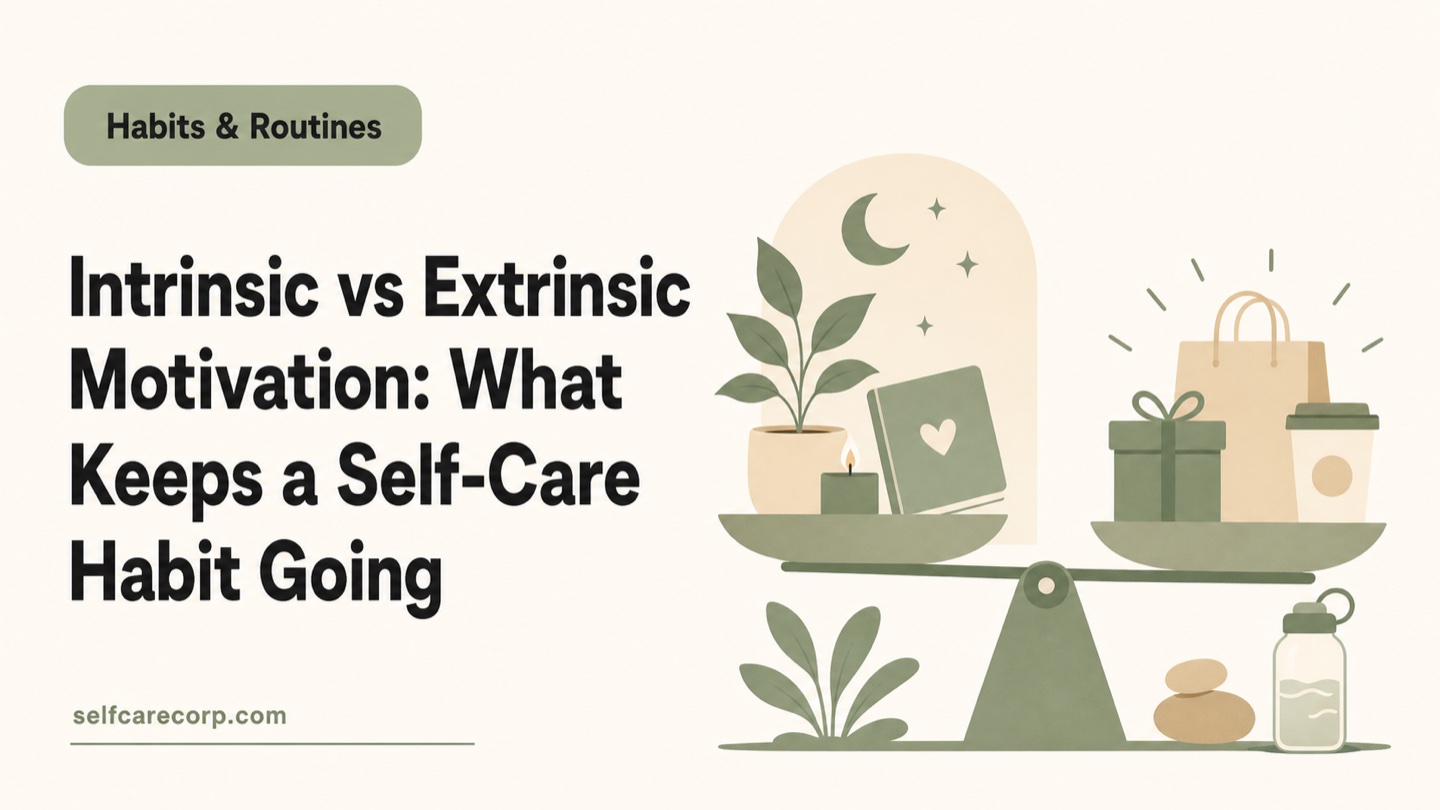
Intrinsic vs Extrinsic Motivation: What Keeps a Self-Care Habit Going
Intrinsic motivation comes from enjoying an activity; extrinsic comes from outside rewards. Here's how each shapes your self-care habits and which one lasts.
Table of contents
Intrinsic motivation means doing something because you enjoy it or find it meaningful. Extrinsic motivation means doing it for an outside payoff, like a reward, praise, a streak on an app, or the relief of dodging guilt. For self-care habits such as moving your body or winding down for sleep, both can get you started, but the intrinsic kind is usually what keeps a habit alive once the novelty wears off. Much of what we understand here comes from self-determination theory, a model of human motivation developed by psychologists Edward Deci and Richard Ryan.
This is a plain-language look at how the two kinds of motivation play out in everyday wellness routines: exercise, sleep, eating, and the small habits in between. It skips clinical motivation struggles and anything a doctor would treat, and it won't tell you which habit to pick. The focus is on why some habits stick while others fade out.
What's the difference between intrinsic and extrinsic motivation?
The simplest split is where the drive comes from. Intrinsic motivation lives inside the activity: you take a walk because the morning air feels good, or you cook because chopping vegetables settles your mind. Extrinsic motivation comes from outside the activity: you walk to hit a step goal, or you cook to slim down before an event.
Neither one is the bad option. According to the Self-Determination Theory site maintained by Ryan and Deci, extrinsic reasons sit on a range, from feeling pressured by rules you didn't choose to genuinely valuing a goal as your own. A nudge from your doctor, a number on a fitness tracker, or a friend's cheering can all help. The trade-off is that outside payoffs tend to lose their grip over time, while enjoyment and personal meaning tend to hold.
Here's a quick way to tell the two apart in your own routines:
| Where it shows up | Intrinsic motivation | Extrinsic motivation |
|---|---|---|
| Source of the drive | The activity itself feels good or meaningful | An outside reward, rule, or consequence |
| Everyday example | Stretching because your body feels looser after | Stretching to earn an app badge |
| When the reward stops | You often keep going anyway | The habit tends to trail off |
Do rewards ever backfire?
Yes, they sometimes do, which surprises people. When you pay yourself (or someone else) to do something that was already fun, the fun can quietly shrink. Psychologists call this the overjustification effect.
The best-known test came from psychologists Mark Lepper, David Greene, and Richard Nisbett in 1973. They watched preschoolers who already loved drawing with markers. Some children were promised a certificate for drawing, some received a surprise certificate afterward, and some got nothing. In the days that followed, the children who had been promised a reward spent less of their free playtime drawing than the others. The promised payoff had turned play into work.
The effect has limits, and that part is useful. A surprise reward handed over after the fact didn't dull interest the way a promised one did. Warm, specific feedback, like "you kept your bedtime three nights running," usually helps rather than hurts, as long as it lands as encouragement instead of pressure. Rewards are not the villain. Dangling them over something you already enjoy is the move to watch.
Rewards can also stumble on a different kind of task: anything that asks for a little creative thinking. Career analyst Dan Pink makes this case in his TED talk "The puzzle of motivation" (TEDGlobal, July 2009), still one of the most-watched TED talks. Pink argues that if-then rewards, the "do this, then you get that" kind, work fine for simple mechanical tasks but often make performance worse once a task needs even rudimentary cognitive or creative skill.
His favorite evidence is a classic puzzle from psychologist Karl Duncker: attach a candle to a wall so the wax doesn't drip, using only the candle, matches, and a box of tacks. The trick is noticing that the tack box can be a shelf, not just a container. Pink retells how psychologist Sam Glucksberg of Princeton timed people solving it and found that the group offered cash prizes took, on average, about three and a half minutes longer than the group offered nothing at all. The money narrowed their attention exactly when the puzzle called for wide, sideways thinking.

Three needs that make a habit feel like your own
Self-determination theory points to three basic psychological needs that feed lasting motivation: autonomy, competence, and relatedness. Deci and Ryan describe these as needs we all share, and when a habit meets them, it starts to feel less like a chore.
- Autonomy is the sense that the choice is yours. A workout you picked because it suits you beats one you feel nagged into. Even small choices count, like which class, which route, or which time of day.
- Competence is the feeling of getting better at something. Starting with a 10-minute walk you can actually finish builds this far more than a punishing plan you quit by Wednesday.
- Relatedness is feeling connected to other people through the habit. A walking buddy, a class, or a group text can carry you on the days your willpower is running low.
Dan Pink popularized a close cousin of this trio for everyday audiences as autonomy, mastery, and purpose, in that same TED talk and his 2009 book Drive. It's a handy way to remember what keeps a habit self-sustaining.
You don't need all three firing at once. Notice which one a wobbly habit is missing, then adjust that piece instead of pushing harder.
Making a habit stick without white-knuckling it
Outside rewards work best as training wheels: helpful at the start, then something to take off. A few practical moves that follow from the research:
- Use rewards to start, not to sustain. A small treat can pull you through the awkward first weeks. Once the habit feels normal, ease off so the activity itself carries it.
- Tie the habit to something you already care about. "I stretch so my back doesn't ache when I play with my kids" holds up better than a step count. That shift toward personal meaning is exactly what self-determination theory points to.
- Shrink it until it's almost too easy. A habit you can finish protects your sense of competence. Two minutes of tidying beats an all-day cleaning plan you keep dreading.
- Follow what you enjoy. If evening walks feel better than morning runs, go with the walks. Enjoyment is information, not a distraction.
It also helps to seek out habits that pull you in on their own. Some activities create a state of deep, easy focus that signals real intrinsic interest, and if you'd like to court that feeling on purpose, it's worth learning how to reach a flow state. Rebuilding a pastime you used to love, like easing back into reading, works the same way: you're reconnecting with an old intrinsic pull rather than forcing yourself.
Most lasting self-care runs on a mix of both kinds of motivation, and that is perfectly fine. Let the outside nudges get you moving, then keep an eye out for the parts you genuinely like. Those are the ones still standing long after the app reminders go silent.
This article is for general information and self-care education only. It is not medical advice, diagnosis, or treatment. For questions about your health, talk to a qualified healthcare professional.